
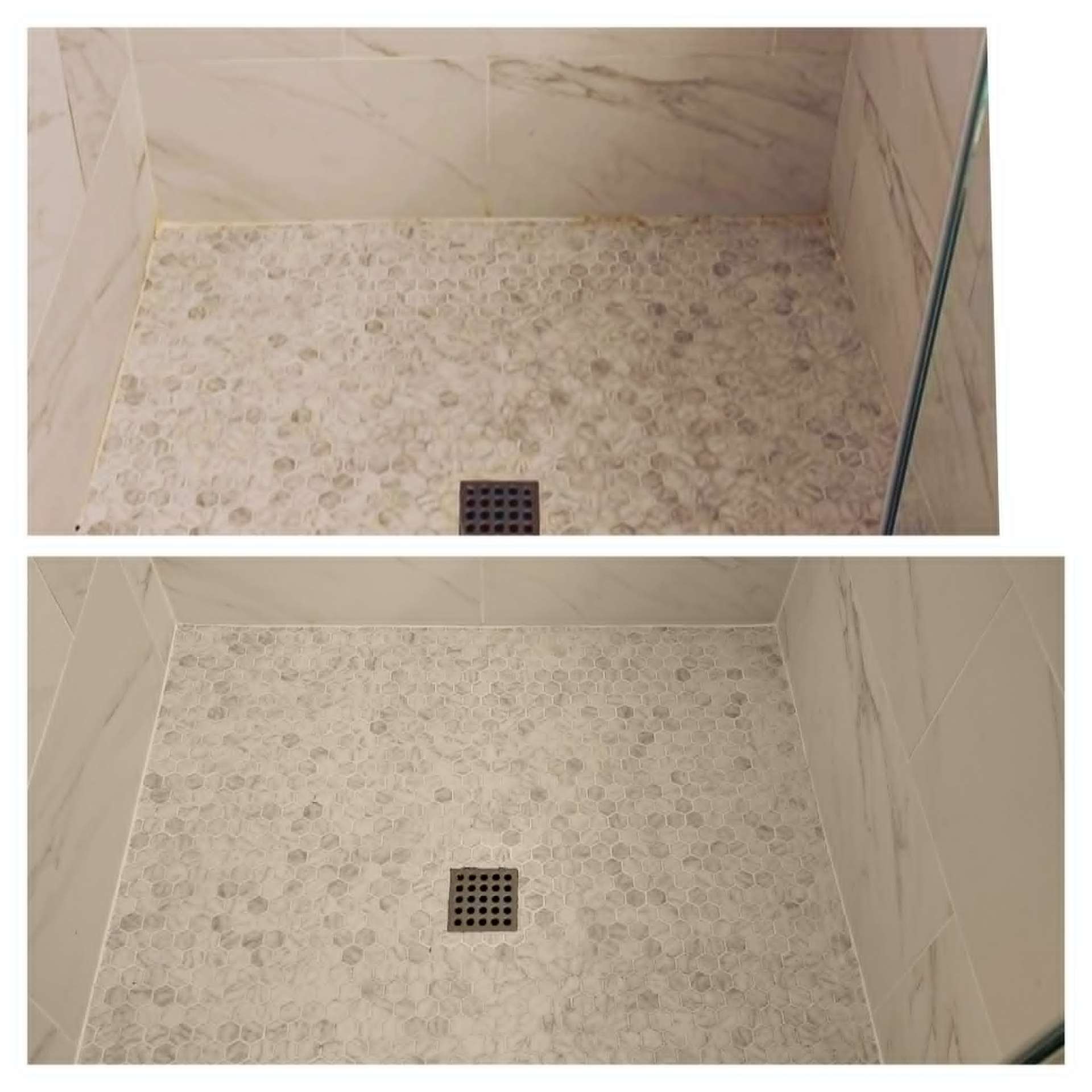
Gilbert tap water averages 17 to 20 grains per gallon, more than triple the national average. Every shower deposits a microscopic layer of calcium and magnesium that bonds to tile, grout, and glass. Scrubbing only removes the latest layer, not the bonded scale underneath, which is why the stains return within days. The fix is a controlled acid neutralization, a deep mineral extraction, and a fresh seal. Done properly, the cycle ends for years.
Why is Gilbert water so hard on shower tile?
Gilbert sits on a groundwater table loaded with calcium carbonate and magnesium. When that water hits a warm shower wall and evaporates, the minerals stay behind. Over months and years, they build a cement-like scale that traps soap film and body oils inside it. That gray, chalky, crusty surface on your Gilbert shower is not dirt. It is mineral concrete.
Why doesn't vinegar, CLR, or scrubbing fix it?
Vinegar dissolves the top 5 to 10 percent of fresh scale. CLR goes a bit deeper but is too aggressive for natural stone and will etch travertine, marble, or limestone permanently. Scrubbing breaks off the loosest layer. None of these touch the bonded mineral matrix underneath, which is why the stains come back within a week. You are cleaning the symptom, not the deposit.
Never use vinegar, lemon, CLR, or any acid on travertine, marble, or limestone shower tile. The calcium in the stone reacts with the acid and etches a dull spot you cannot scrub out. We see this in Gilbert homes weekly.
What actually removes hard water from shower tile?
Professional removal uses tile-specific mineral dissolvers matched to your surface, applied at controlled dwell times so the scale releases without damaging the substrate. We follow with a high-pressure hot water extraction that flushes the dissolved minerals down the drain instead of letting them re-deposit. For natural stone we use a non-acid mineral remover specifically designed for calcium-based stones.
Step by step: how we restore a Gilbert shower
- Inspect tile, grout, and glass to identify surface type and scale thickness
- Apply the correct dissolver: acidic for porcelain and ceramic, non-acid mineral remover for travertine, marble, or limestone
- Controlled dwell, light agitation, then full hot water extraction
- Repeat on heavy build-up zones near the floor and along grout lines
- Deep clean grout with high heat to lift trapped soap and body oil
- Penetrating sealer on natural stone, or color seal on grout, to slow future scale bonding
- Glass restoration with mechanical polishing and a hydrophobic glass coating
Why hard water stains keep coming back after DIY
- Bonded scale is still in the pores and acts as a seed for new deposits
- No sealer is reapplied, so fresh minerals bond directly to bare grout and stone
- Soap film keeps trapping new minerals against the surface
- Glass is not properly polished, so micro-pits hold every drop
How long does a professional restoration last in Gilbert?
With the right sealer reapplied, a Gilbert shower stays clear for 2 to 4 years before maintenance is needed. With a quarterly Zone membership clean, that stretches indefinitely because scale is never given time to bond. Without a softener and without sealing, fresh deposits start within months.
Should I install a water softener?
A whole-home softener is the single most effective long-term solution for Gilbert hard water on tile, glass, and grout. Sealing buys you years. A softener buys you decades. Many of our Gilbert clients restore the shower first to get a clean baseline, then install a softener to keep it that way.
Internal links you may want next
For our full shower restoration process, see our /services/shower-restoration page. For ongoing protection that keeps Gilbert hard water from rebuilding, see /the-zone. To get on the schedule for a free in-home assessment, call (480) 352-0392.