Travertine is a calcium-based sedimentary stone with thousands of microscopic pores per square inch. In Arizona, those pores face brutal UV, monsoon humidity swings, and 17 to 20 grain hard water. Big-box impregnating sealers are formulated for temperate climates and fail in 6 to 12 months here. Professional-grade sealers carry higher solids content, UV stabilizers, and the bond chemistry to hold up in the desert for 3 to 5 years. The cost difference at install is small. The cost difference at year three is enormous.
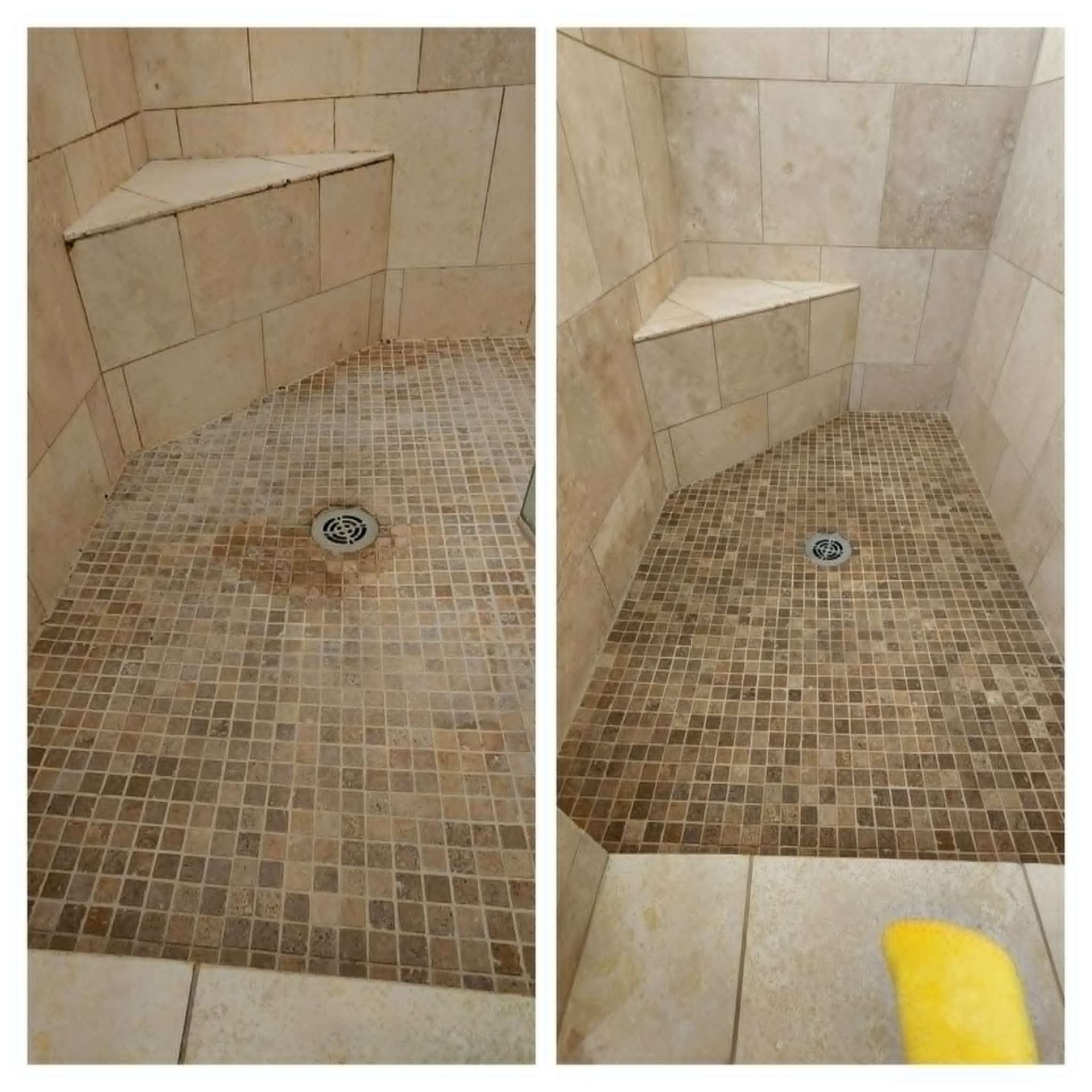
What makes Arizona so hard on travertine sealers?
- UV index in the East Valley regularly hits 11+, breaking down sealer polymers 40 percent faster than northern climates
- Monsoon humidity swings from 10 percent to 60 percent in hours, expanding and contracting sealed pores
- Hard water deposits crust onto sealed surfaces and lift the sealer with them when they release
- Pool chemicals splash onto outdoor travertine and chemically attack standard sealers
- Indoor travertine is exposed to acidic kitchen and bathroom cleaners that strip protection
Why big-box travertine sealers fail in Arizona
Most big-box sealers are 10 to 15 percent solids, water-carrier impregnators designed for a 1 to 2 year reseal cycle in a temperate climate. In Arizona, the carrier flashes off the surface before the solids can fully penetrate the dense outer pore wall of travertine. The result is a thin film at the top that wears off in months, not years.
What does a professional-grade sealer do differently?
- Higher solids content (typically 25 to 40 percent) for deeper pore penetration
- Solvent or hybrid carrier formulated to stay liquid long enough to reach the inner pore wall
- UV stabilizers that resist breakdown in high-UV environments
- Oleophobic and hydrophobic chemistry, so the sealer repels both oil and water
- Vapor permeability, so trapped moisture can escape and not blister the surface
- Color enhancement options that deepen the natural tones without going wet or plasticky
We test multiple sealers on every Arizona travertine job before committing to one across the floor. A Chandler entryway, a Mesa patio, and a Gilbert master bath each get the sealer chemistry matched to traffic, exposure, and finish.
How long does a professional travertine sealer last in Arizona?
Indoor honed travertine, sealed professionally with a high-solids impregnator, lasts 3 to 5 years before needing a maintenance reseal. Polished travertine lasts 4 to 6 years because the polished surface is denser. Outdoor travertine, patios, and pool decks, lasts 2 to 3 years because of direct UV and pool chemicals. Big-box product on the same surfaces lasts 6 to 12 months.
How is travertine professionally sealed?
- Deep clean with stone-safe alkaline cleaner to lift embedded soil
- Hot water extraction to flush the cleaner and any dissolved soil
- Full dry, minimum 24 hours, longer in Arizona winters
- Test the chosen sealer on an inconspicuous tile to confirm color and absorption
- First coat applied liberally, dwell to absorb, then wipe off all surface residue
- Second coat if the stone is still absorbing, repeat wipe-off
- 24 to 72 hour cure before water exposure
- Final inspection with water bead test on multiple tiles
What about color enhancing sealers?
Color enhancing sealers deepen the natural variations of travertine and make veining and movement pop. We use them most often on honed and tumbled travertine where the stone has gone flat over the years. The trade-off is that color enhancers require slightly more frequent maintenance, every 2 to 4 years instead of 3 to 5, because the visible look telegraphs wear earlier.
Why does this matter for your floor?
A travertine floor sealed with the wrong product in Arizona will start absorbing stains, etching from spills, and showing dull traffic lanes within a year. By year three you are looking at a $4,000 to $12,000 restoration. A professional seal at $1.50 to $3.50 per square foot, refreshed every 3 to 5 years, prevents that entirely. The math always favors doing it right.
Ready to seal it the right way?
For our full travertine process, see /travertine-restoration. For ongoing protection that includes maintenance reseals before the surface fails, see /the-zone. Free in-home assessments across Chandler, Gilbert, Mesa, Queen Creek, Scottsdale, and Paradise Valley. Call (480) 352-0392.